


Как литийсиликатный упрочнитель позволил устранить пылеобразование в бетоне и снизить затраты на техническое обслуживание на логистическом складе с высокой проходимостью.
A logistics operator managing a 45,000 square meter distribution center was experiencing a persistent and escalating concrete floor problem. The facility handled fast-moving consumer goods on a three-shift operation, with heavy forklift traffic running continuously across the main distribution floor. Within eighteen months of the facility opening, concrete dusting had become a significant operational problem — fine powder was accumulating on stored goods, contaminating product packaging, and clogging forklift wheel bearings at a rate that was generating measurable maintenance costs.
The facility's floor had been specified as a standard power-floated concrete slab with no surface treatment beyond the initial construction finish. In a light-use environment this would have been adequate. Under continuous heavy forklift loading across three shifts, the surface laitance layer — the weak, porous zone at the top of any concrete slab — was abrading progressively, generating the dust that was causing operational problems.
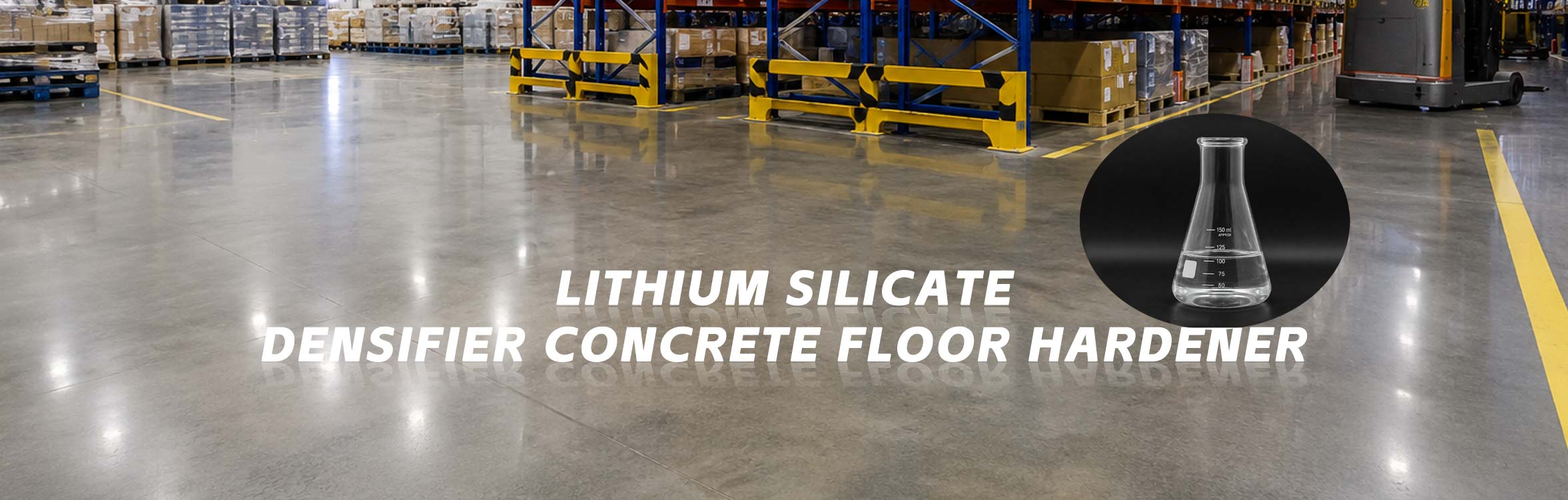
The operator contacted us after evaluating two alternatives: epoxy coating and lithium silicate concrete floor hardener treatment. Epoxy was rejected on cost and maintenance grounds — recoating a 45,000 square meter floor every three to five years was not commercially viable for the facility's operating model. Lithium silicate densifier was selected for evaluation.
The Problem in Detail
Before specifying a treatment, we conducted a surface assessment of the floor. Schmidt hammer testing confirmed surface hardness significantly below the slab's bulk strength — consistent with a weak laitance layer rather than a fundamental concrete quality problem. Water absorption testing showed 24-hour absorption of 6.8% on untreated surface samples, indicating high porosity in the surface zone. Pull-off adhesion testing on core samples showed the laitance layer separating from the underlying concrete at 0.8 MPa — well below the 1.5 MPa threshold for surfaces intended for heavy forklift traffic.
The diagnosis was straightforward: the surface laitance had not been sufficiently removed during construction finishing, and the porous, low-strength surface zone was disintegrating progressively under wheel loading. A penetrating densifier that could react with the calcium hydroxide within this zone and convert it to additional C-S-H gel — filling the pores and hardening the surface from within — was the technically appropriate solution.
The Solution
We recommended our colloidal lithium silicate solution applied in two passes at a combined coverage rate of 8 m²/L, allowing full penetration and reaction between passes.
The choice of lithium silicate over sodium or potassium silicate alternatives was based on particle size. Colloidal lithium silicate solution particles are significantly smaller than sodium or potassium silicate, allowing deeper penetration into the fine capillary pore network of the surface zone before the reaction with calcium hydroxide occurs. For a floor with existing surface deterioration, depth of reaction was critical — a shallow surface treatment would wear through rapidly under the same loading that had caused the original problem.
The application was completed during a scheduled weekend maintenance closure — 45,000 square meters treated in two shifts without disrupting the facility's operating schedule.
Results
Surface testing was conducted at 7 days and 28 days post-treatment.
| Performance Indicator | Before Treatment | 7 Days Post | 28 Days Post |
|---|---|---|---|
| Surface Hardness (Schmidt) | 28–32 | 38–42 | 44–48 |
| Water Absorption (24hr) | 6.8% | 1.9% | 1.2% |
| Pull-off Adhesion | 0.8 MPa | 1.6 MPa | 2.1 MPa |
| Dust Generation (visual) | Severe | Minimal | None |
| Forklift Bearing Replacement | 8/month average | — | 1/month |
Surface hardness increased by over 50% at 28 days. Water absorption dropped from 6.8% to 1.2% — an 82% reduction that effectively eliminated capillary moisture transport through the treated zone. Pull-off adhesion more than doubled, confirming that the laitance layer had been consolidated rather than simply surface-sealed.
Forklift wheel bearing replacements — the most direct operational cost indicator the facility tracked — dropped from an average of eight per month to one per month within the first 60 days of operation post-treatment. The facility manager calculated a full return on treatment cost within four months based on maintenance savings alone, before accounting for reduced product contamination and cleaning labor.
Client Feedback
dddhhhWe had been dealing with the dusting problem since the facility opened and had tried several cleaning and sealing products without lasting results. The lithium silicate treatment was the first thing that actually fixed the underlying problem rather than just masking it temporarily. The maintenance cost reduction was faster and larger than we expected.dddhhh
— Facilities Manager, Logistics Distribution Center (name withheld)
Conclusion
For warehouse and logistics facility operators dealing with concrete floor dusting, lithium silicate warehouse floor treatment addresses the root cause — surface porosity and weak laitance — rather than covering it with a coating that will eventually fail. As a dedicated lithium silicate densifier concrete floor hardener supplier, we provide colloidal lithium silicate solution with verified solid content, penetration depth data, and full application support for new and existing concrete floor projects.
Contact us to request a sample, technical data sheet, or site assessment for your concrete floor treatment requirements.